Thursday, October 30, 2025

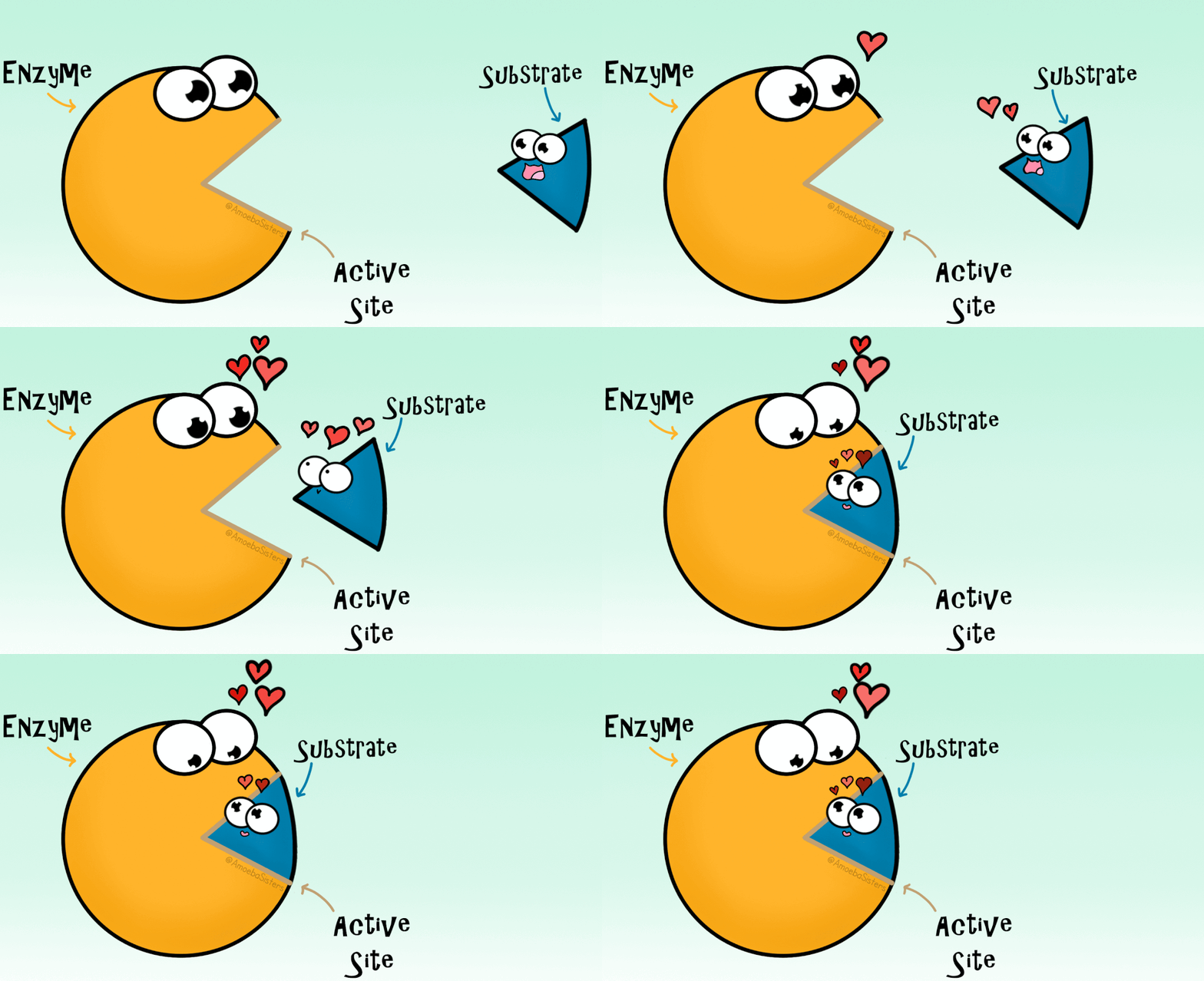
3.2 Environmental Impacts on Enzyme Function


Today's Learning Objective(s):

·  Explain how changes to the structure of an enzyme may affect its function.

·  Explain how the cellular environment affects enzyme activity.

#

Tasks:

1

Enzyme Structures  – Quizizz   

Complete the game.

2

Enzymes as Catalysis 

Small groups are given the name of an enzyme.

You are to determine the following attributes:

1) enzyme name

2) reaction equation

3) types of reactions (exergonic, endergonic, catabolic, anabolic, etc.) 4) importance to living organisms.


You are to put their information on newsprint


3

Teacher Notes > Energy of Activation

Review notes.

4

Revisit 2D Enzyme

Can you alter your model to add:

1) Cofactor
2) Noncompetitive inhibitor


5

Teacher Notes > Big Picture Review Enzyme Function & Environmental Let’s look at some critical parts of energy in living organisms.

6

Check for Understanding - Enzyme Structure & Function  

Complete the multiple choice questions.


Homework

Check for Understanding > Enzyme Function

Quizlet - Enzymes

FRQ Enzymes - Study Guide

Video 3.2


Upcoming Assessments

11/3/25 FRQ: Enzyme Function – a quiz (study guide)

11/7/25 Quiz: Enzymes November (study guide)

11/17/25 Quiz: Energy in Living Organism & Photosynthesis (study guide)

11/20/25 Quiz: Cellular Respiration (study guide)

11/22/25 Test: Cellular Energetics – unit 3 (study guide)


Calendar Notes

Thursday, 10/30/25 Q1 Grading Period Ends

Monday, 11/3/25 Q2 Grading Period Begins

11/26/25 – 12/1/25 Thanksgiving Break

12/2/25 School Resumes (unit 4 start)

Wednesday, October 29, 2025

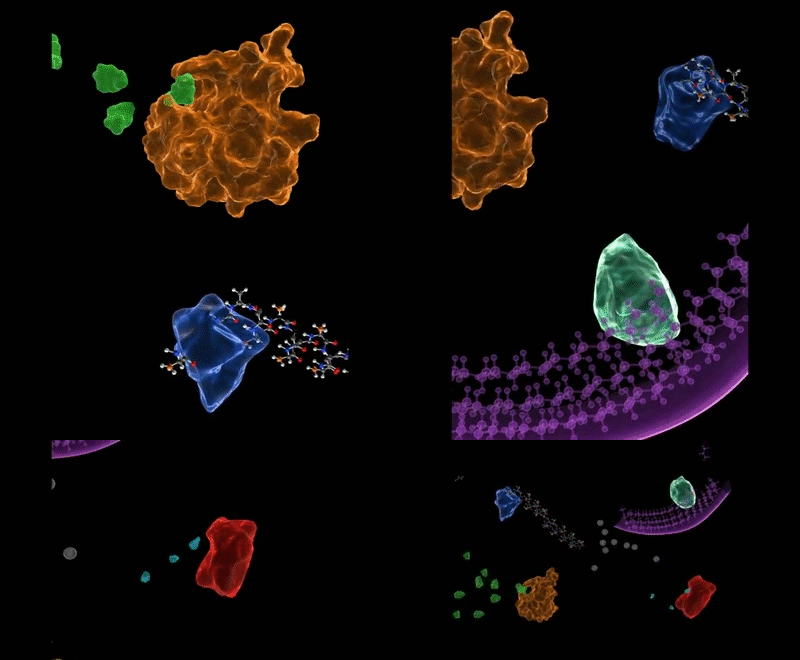
3.1 Enzymes


Today's Learning Objective(s):

· Explain how enzymes affect the rate of biological reactions.

#

Tasks:

1

Enzymes Word Cloud

What do you remember about enzymes from biology? 

2

Reading about Structures of Enzymes 

You are to read about the structure of enzymes. You are to identify the structures of an enzyme. 


Resource


3

Modeling Enzyme Structures

Using a 2D model, what can you create to show the different structures of an enzyme?  Use the crafting materials in the lab. You are to show how you modeled your enzyme.


4

Going Deeper – What makes up an enzyme?

Going Deeper – 

What makes up an enzyme? 

 What are some of the different types of enzymes?

Link

Paper copy in class


5

Teacher Notes > Structure of Enzymes 

Let’s look at the enzyme-substrate complex, substrate specificity, inhibitors (competitive and noncompetitive) and cofactors. 


6

Quizlet Blast – Enzyme Structure Vocabulary 

You are to play blast to review the lesson vocabulary.


Homework

 Check for Understanding - Examine the ATP cycle (for Thursday)

Read & Study Textbook Ch 6.3

Quizlet - Enzymes
Video 3.1.1  Video 3.1.2
Video 3.1.3  MCQ lesson 3.1

Upcoming Assessments

11/3/25 FRQ: Enzyme Function – a quiz (study guide)

11/7/25 Quiz: Enzymes November (study guide)

11/17/25 Quiz: Energy in Living Organism & Photosynthesis (study guide)

11/20/25 Quiz: Cellular Respiration (study guide)

11/22/25 Test: Cellular Energetics – unit 3 (study guide)


Calendar Notes

Thursday, 10/30/25 Q1 Grading Period Ends

Monday, 11/3/25 Q2 Grading Period Begins

11/26/25 – 12/1/25 Thanksgiving Break

12/2/25 School Resumes (unit 4 start)

Tuesday, October 28, 2025

Introduction to Energy of Living Organisms (Start Unit 3)


Today's Learning Objective(s):

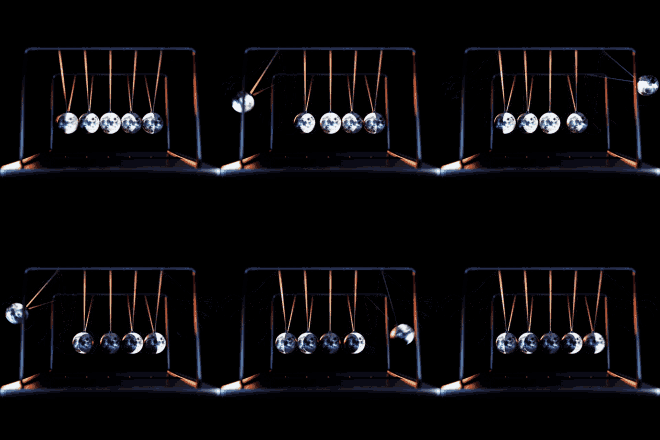
·  Compare potential and kinetic energy.

·  Describe the first and second laws of thermodynamics.

·  Examine how organization and structure of living things is related to heat and entropy.

#

Tasks:

1

Food Chain

You are to create a food chain. Use what you remember from previous biology classes to draw upon. No creativity this morning, ask AI for a list of organisms in a food chain with five levels. You are to show in their model the movement of energy and nutrients. 

2

Forms of Energy 

You are to recall the various forms of energy. Then, in teams they are to consider which are available to living organisms?  Why? How?  Examples?

3

Laws that Govern Energy 

You are to read in the textbook about the laws that govern energy. You will create a T-Chart (Endergonic v. Exergonic) looking at the interactions of different types of reactions (endergonic, exergonic, anabolic, catabolic). You can go beyond the text and use Google to add more detail to the lists.

6.1 Cells and the Flow of Energy

6.2 Metabolic Reactions and Energy Transformations


4

ATP: Coupled  Reaction 

You then are to read about coupled reactions of ATP. How does ATP fit into the T-chart? Read and add even more detail.

6.2 Metabolic Reactions and Energy Transformations


5

Teacher Notes > Energy in Living Organisms

Let’s look at some critical parts of energy in living organisms.

6

Check for Understanding - Examine the ATP cycle of coupled reactions

Which part of the process exergonic or endergonic? Anabolic or catabolic?  Which part of the reaction has the highest potential energy? Lowest potential energy? What might be the source of energy for ATP dehydration synthesis reactions?


Homework

 Check for Understanding - Examine the ATP cycle (for Thursday)

Read & Study Textbook Ch 6.2

Quizlet - Energy Living Organisms


Upcoming Assessments

11/3/25 FRQ: Enzyme Function – a quiz (study guide)

11/7/25 Quiz: Enzymes November (study guide)

11/17/25 Quiz: Energy in Living Organism & Photosynthesis (study guide)

11/20/25 Quiz: Cellular Respiration (study guide)

11/22/25 Test: Cellular Energetics – unit 3 (study guide)


Calendar Notes

Thursday, 10/30/25 Q1 Grading Period Ends

Monday, 11/3/25 Q2 Grading Period Begins

11/26/25 – 12/1/25 Thanksgiving Break

12/2/25 School Resumes (unit 4 start)
Monday, October 27, 2025

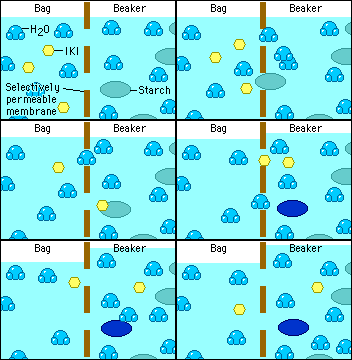
Test Corrections + Lab: Osmosis CER


Today's Learning Objective(s):

Review all learning objectives on the resource site. .

#

Tasks:

1

Test Corrections

Review the test from Friday.

No notes, Chromebooks / phones allowed), but you can adjust your answers


MCQs (part A – 20 points)


Items with a yellow highlight mark contain an incorrect response


Write your new answer under the line provided, but do not erase your previous responses.


FRQs (part B – 12 points)


Checkmark on items indicates full point value.


Items with underlined areas of the prompt have an incorrect, missing, or not appropriate response.


Use a separate sheet of composition paper to rewrite the entire response for resubmission.


- Do not erase your previous responses


- Corrected responses will receive 0.5 points for each item


After corrections, the test will be reevaluated, and new scores will be posted to Google Classroom/Alma.


Score sheet & Scantron answer sheet will be attached to the test and returned to the assessment folder for your review


Bonus Points for AP Classroom Homework Completion


Bonus Points to be added tonight*

All videos watched

1%

All Lesson MCQs Attempted

1%

Progress Check MCQs

1%

Progress Check FRQs

1%

Total Possible

4% Bonus

*See progress report printed and placed in the assessment folder.


2

Osmosis Lab Parts A→C & CER (part D)


Part D CER
This part of the lab is a group evaluation.


You and your lab team will create an argument about the molar concentration of the unknown solution and the water potential of the carrot cells. An argument is typically set up with the claim (in this case your suspected unknown molar concentration), evidence gathered throughout the lab experience, and reasoning (using what you’ve learned about tonicity and osmoregulation to support your claim.


Guiding Question:  What question were you trying to answer in the experiment?

Our Claim: What is your conclusion? You claim should address:

Unknown Solutions A→F (part A)

Water potential of the carrots (part C)

Mystery (?) solution with the carrots


Our Evidence: What data or information did you gather to lead you to the claim? Use your packet tables and calculations!


Our Justification  Reasoning: What ideas or principles from class support your claim? Does the evidence seem reasonable with what you know? Use class notes, slides, textbook, etc.


The score for the CER will be a group evaluation.  The presentation will be scored using the following rubric.


Presentations last 20 minutes of class.


Homework

Read & Study Textbook Ch 6.1


Upcoming Assessments

11/3/25 FRQ: Enzyme Function – a quiz (study guide)

11/7/25 Quiz: Enzymes November (study guide)

11/17/25 Quiz: Energy in Living Organism & Photosynthesis (study guide)

11/20/25 Quiz: Cellular Respiration (study guide)

11/22/25 Test: Cellular Energetics – unit 3 (study guide)


Calendar Notes

Thursday, 10/30/25 Q1 Grading Period Ends

Monday, 11/3/25 Q2 Grading Period Begins

11/26/25 – 12/1/25 Thanksgiving Break

12/2/25 School Resumes (unit 4 start)