Friday, October 24, 2025

Test: Cells (unit 2) & Good Luck! 🍀


Tasks:

T
O
D
A
Y

Test: Cells

Part A. MCQs

#1-20

Write your name on the test packet

- Process of elimination

- Sketch, draw, and/or notes on the margins

 Write on the test answer sheet

-   Use the Scantron Sheet

o   Items 1-20 and bubble a → d

o   Make no stray marks

Part B. FRQs

Write your name on the part  2 booklet

- Use the booklet to write your responses in the spaces provided

- Follow the directions as provided


Homework

Study! Test corrections! 


Calendar Notes

Thursday, 10/30/25 Q1 Grading Period Ends

Thursday, October 23, 2025

Unit Review & Lab: Osmosis CER & end of unit 2


Today's Learning Objective(s):

Review all learning objectives on the resource site.

#

Tasks:

1

Gimkit: Unit 2

Play the game.

2

Osmosis Lab Parts A→C & CER (part D)


Part D CER
This part of the lab is a group evaluation.


You and your lab team will create an argument about the molar concentration of the unknown solution and the water potential of the carrot cells. An argument is typically set up with the claim (in this case your suspected unknown molar concentration), evidence gathered throughout the lab experience, and reasoning (using what you’ve learned about tonicity and osmoregulation to support your claim.


Guiding Question:  What question were you trying to answer in the experiment?

Our Claim: What is your conclusion? You claim should address:

Unknown Solutions A→F (part A)

Water potential of the carrots (part C)

Mystery (?) solution with the carrots


Our Evidence: What data or information did you gather to lead you to the claim? Use your packet tables and calculations!


Our Justification  Reasoning: What ideas or principles from class support your claim? Does the evidence seem reasonable with what you know? Use class notes, slides, textbook, etc.


The score for the CER will be a group evaluation.  The presentation will be scored using the following rubric.


Presentations on Monday, October 27.


3

Study Session


Review the content from unit 2. Test tomorrow


Test: Cells (unit 2)


4

Quiz: Results and Corrections   


Review your results on the quiz. Corrections (MCQs only) for 0.5 points.


Homework

Test - Study Guide

Progress Check MCQ
Progress Check FRQ

Upcoming Assessments

Tomorrow  Test: Cells (unit 2)


Calendar Notes

Thursday, 10/30/25 Q1 Grading Period Ends


Wednesday, October 22, 2025

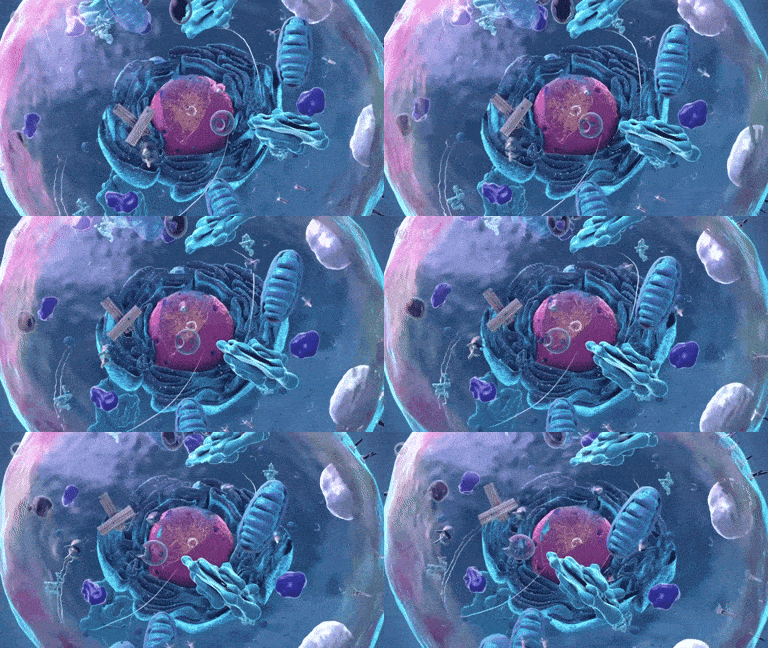
2.10 Origins of Cell Compartmentalization


Today's Learning Objective(s):

Describe the membrane bound structures of the eukaryotic cell.

Explain how internal membranes and membrane bound organelles contribute to compartmentalization of eukaryotic cell functions.

Describe similarities and/or differences in compartmentalization between prokaryotic and eukaryotic cells.


#

Tasks:

1

Endosymbiosis: Lynn Margulis 


Read the  Article  .

How is this related to cell compartmentalization?


Then, watch the video:


YouTube


2

Teacher Notes: Origins of Eukaryotic Cells


Let’s look at the endosymbiosis theory.


3

Osmosis Lab Parts A→C & CER (part D)


Part D CER
This part of the lab is a group evaluation.


You and your lab team will create an argument about the molar concentration of the unknown solution and the water potential of the carrot cells. An argument is typically set up with the claim (in this case your suspected unknown molar concentration), evidence gathered throughout the lab experience, and reasoning (using what you’ve learned about tonicity and osmoregulation to support your claim.


Guiding Question:  What question were you trying to answer in the experiment?

Our Claim: What is your conclusion? You claim should address:

Unknown Solutions A→F (part A)

Water potential of the carrots (part C)

Mystery (?) solution with the carrots


Our Evidence: What data or information did you gather to lead you to the claim? Use your packet tables and calculations!


Our Justification  Reasoning: What ideas or principles from class support your claim? Does the evidence seem reasonable with what you know? Use class notes, slides, textbook, etc.


The score for the CER will be a group evaluation.  The presentation will be scored using the following rubric.


Presentations on Monday, October 27.


4

Quiz: Results and Corrections   


Review your results on the quiz. Corrections (MCQs only) for 0.5 points.


Homework

Watch Daily Video  2.9

MCQs 2.9


Upcoming Assessments

FRIDAY  Test: Cells (unit 2)


Calendar Notes

Thursday, 10/30/25 Q1 Grading Period Ends


Tuesday, October 21, 2025

2.9 Cell Compartmentalization & Quiz


Today's Learning Objective(s):

Describe the membrane bound structures of the eukaryotic cell.

Explain how internal membranes and membrane bound organelles contribute to compartmentalization of eukaryotic cell functions.

Describe similarities and/or differences in compartmentalization between prokaryotic and eukaryotic cells.


#

Tasks:

1

Quiz: Cellular Transport

Complete each item on the quiz.


Paper/Pencil

Calculator Use


2

Where did eukaryotic cells come from?


YouTube


Then, consider the following:


"If you think hard enough you might begin to feel like our cells are more than just ourselves." Journey to the Microcosmos


What do you think Hank Green meant by this statement?


3

Exploring Cell Compartmentalization

 Textbook 4.3 Intro. to Eukaryotic Cells

Reread about cell compartmentalization chapter 4.3 (PG 64-65). Then answer the following questions:

1) Summarize the benefits of compartmentalization found in eukaryotic cells.

2) Examine why organelles increase cell efficiency and function

3) Explain the origins of the nucleus, chloroplast, and mitochondria of eukaryotic cells.


Homework

Watch Daily Video  2.9

MCQs 2.9


Upcoming Assessments

FRIDAY  Test: Cells (unit 2)


Calendar Notes

Thursday, 10/30/25 Q1 Grading Period Ends


Monday, October 20, 2025

2.8 Mechanisms of Transport & Osmosis Lab


Today's Learning Objective(s):

Explain Describe the processes that allow ions and other molecules to move across membranes.

Tasks:


1

Revisit Membrane Permeability

Crash Course Biology - Let's watch a video to review topic 2.5 Membrane Transport. 


2

Mechanisms of Transport

From AP Biology CED:


"Metabolic energy (such as that from ATP) is required for active transport of molecules and ions across the membrane and to establish and maintain electrochemical gradients."


Use the large paper and post-it notes to classify the movement of materials with the membrane and membrane proteins as listed on the sheet.


3

Chart It Out: Bulk Transport

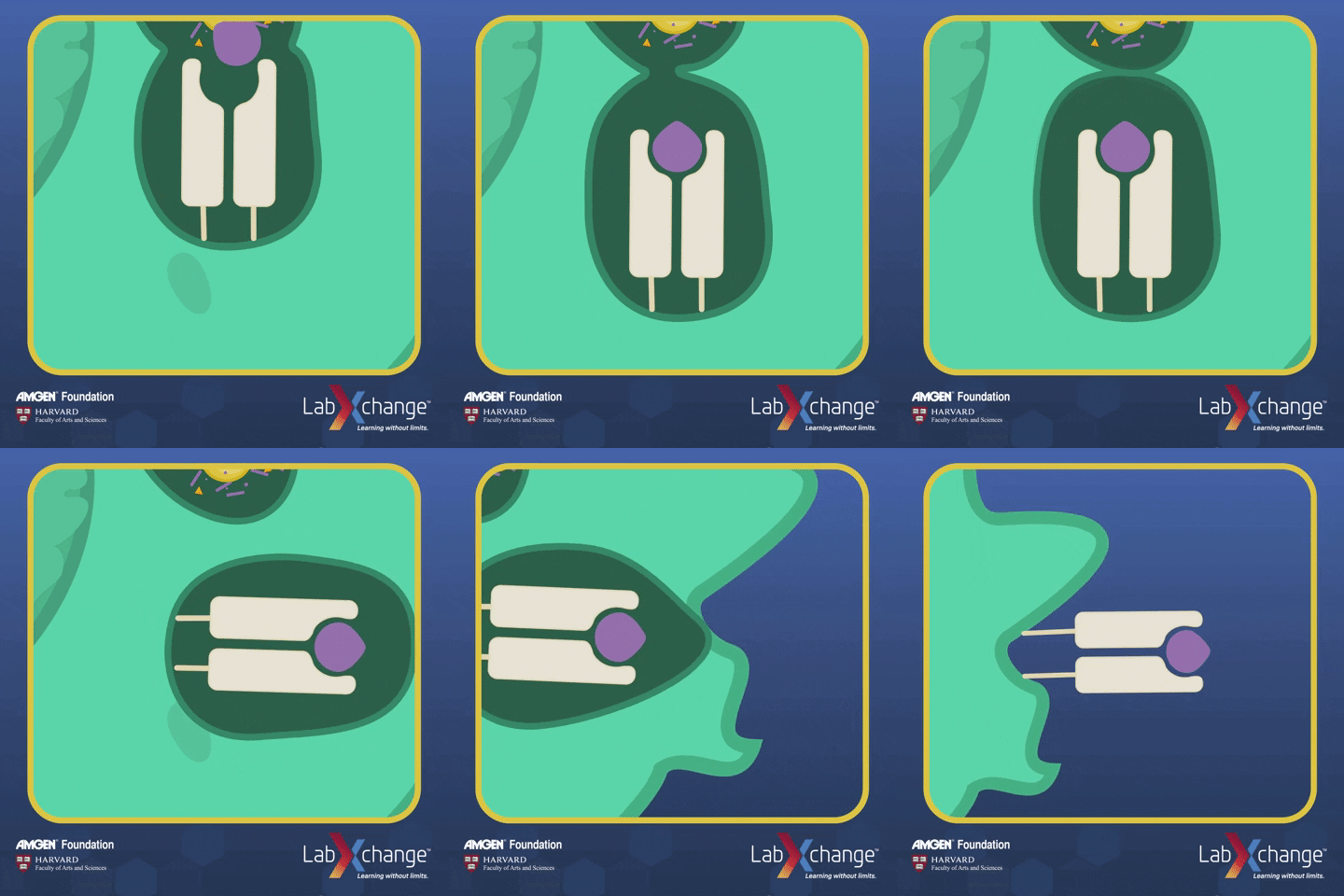
What are the different means to bulk transport material?  You are to compare the different bulk transport methods:


 exocytosis

 endocytosis

 phagocytosis

 pinocytosis

 receptor-mediated endocytosis


4

Lab: Osmosis Continued

 Complete the different parts of the osmosis lab:

 Part A Be sure both charts have been completed

Note: (14.) Ratioanale will be in the CER in part D

Construct the graph

Part B

Be sure to complete the table with the % change calculations


Part C

Calculate the water potential of the carrot

Part D

CER  - Where the claim is to be your explanations for the unknown molar concentrations A→F (part A) and Mystery? (part b).


From the instructions.


Guiding Question: What question were you trying to answer in

the experiment?

Our Claim: What is your conclusion?

Our Evidence: What data or information did you gather to lead

you to the claim?

Our Justification or Reasoning: What ideas or principles from

class supports your claims? Does the evidence seem reasonable

with what you know?


Bonus -  Interesting Article
Japan Just Switched on Asia’s First Osmotic Power Plant, Which Runs 24/7 on Nothing But Fresh Water and Seawater 

Type a response in Google Classroom > Classwork>  🎖️Bonus


"What is the relationship to osmoregularity and using water potential in the technology mentioned in the article?"

Homework

Osmosis Lab

Watch Daily Video  2.8

MCQs 2.8

Quiz Tuesday - Study


Upcoming Assessments

TOMORROW   Quiz: Cell Transport 

FRIDAY  Test: Cells (unit 2)


Calendar Notes

Thursday, 10/30/25 Q1 Grading Period Ends