Friday, December 12, 2025

4.4 Feedback continued


Today's Learning Objective(s):

·       Explain how positive and negative feedback helps maintain homeostasis.

#

Tasks:

1

Sample Questions - Feedback
Use the Wayground task to check your progress on negative and positive feedback.    

2

Modeling Blood Glucose Homeostasis
Continue with the models. What loops would involve digestive / circulatory systems to maintain a constant supply of glucose? How can this be displayed in the model


Negative feedback; there is a set point for glucose in the blook. Model how the systems (and cell signals insulin and glucagon) work to maintain blood glucose levels.


3

Explanations – Blood Homeostasis

Let’s look at the models that were created. Use a gallery walk to see the examples the different groups produced.


4

Parathyroid Hormone (PTH) Regulates Body Calcium


Read about PTH and calcium in the body. In this example, negative feedback is used to keep calcium levels at an acceptable level in the blood. Answer the analysis questions.


5

Review  Parathyroid Hormone (PTH) Regulation
Let’s see what we learned about this signaling pathway and feedback mechanism. Use the large sheet of paper to work in your teams.  

6

Pre-Lab: Cell Communication

Obtain a lab packet. Complete the pre-lab tasks. Homework if not completed in class.


Homework

Pre-lab: Cell Communication (not available digitally)


Upcoming Assessments

12/16/25 Quiz: Feedback

12/19/25 Quiz: Cell Cycle

12/22/25 Test: Cell Communication & Cell Cycle


Calendar Notes

12/24/25 – 1/4/26 Winter Break

1/5/26 School Resumes (unit 5 start)
Thursday, December 11, 2025

4.4 Feedback continued


Today's Learning Objective(s):

·        Explain how positive and negative feedback helps maintain homeostasis.

#

Tasks:

1

Quiz: Cell Communication
Complete the quiz.   

2

Digestive System
You are to start by modeling the digestive system. What does it take to process the food we eat? Organs and Roles You are to research the different roles played by organs in the digestive system


3

Explanations – Organs of the Digestive System

Explaining models – Students are to explain their models of the digestive system


4

Feedback Loop - Insulin, Glucagon, Glucose and Glycogen 


Students are to examine the feedback loop in digestion and maintaining blood glucose levels. What are the feedback loops?  


5

Modeling Blood
Homeostasis You are to add to their models. What loops would involve digestive / circulatory systems to maintain a constant supply of glucose? How can this be displayed in the model

Let’s use new vocabulary.

6

Checkpoint > Blood Homeostasis

Complete the worksheet.


Homework

MCQs 4.4

 ✅Checkpoint > Blood Homeostasis


Upcoming Assessments

12/16/25 Quiz: Feedback

12/19/25 Quiz: Cell Cycle

12/22/25 Test: Cell Communication & Cell Cycle


Wednesday, December 10, 2025

4.4 Feedback


Today's Learning Objective(s):

·        Explain how positive and negative feedback helps maintain homeostasis.

#

Tasks:

1

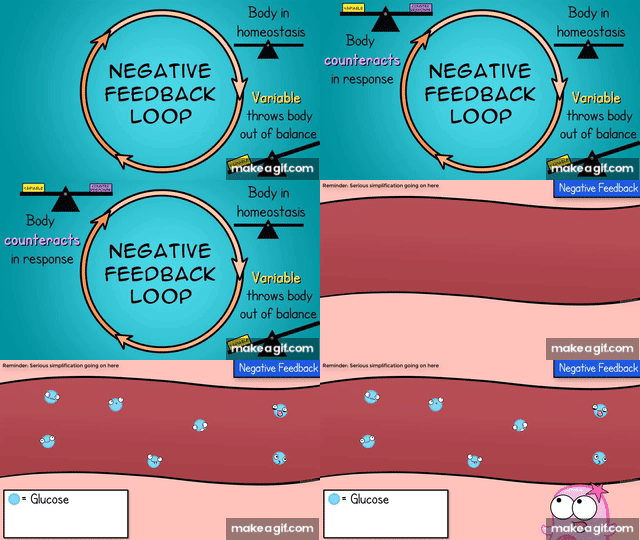
Video: Feedback
Let’s are to watch a video by FuseSchool on feedback mechanisms 


2

T-Chart: Negative and positive Feedback 


You are to create a T-chart for negative and positive feedback. You should use internet searches to fill the chart. Human anatomy and physiology examples should be added to the chart.


3

Notes > Feedback Mechanisms


Teacher goes over the general differences between the feedback mechanisms. Example: Homeostasis in Blood Erythrocytes 


4

Classifying Homeostasis Scenarios  


You are to read scenarios. You are to determine if each is positive or negative feedback. 


5

Quizlet Vocabulary Review


Let’s use the new vocabulary.

6

Review  - Quiz Tomorrow


Try the MCQs


Homework

📕Textbook 34.1
📺Daily Video 4.4

Quizlet Review

Quiz Study Guide


Upcoming Assessments

TOMORROW Quiz: Cell Communication

12/16/25 Quiz: Feedback

12/19/25 Quiz: Cell Cycle

12/22/25 Test: Cell Communication & Cell Cycle


Calendar Notes

12/24/25 – 1/4/26 Winter Break

1/5/26 School Resumes (unit 5 start)

Tuesday, December 9, 2025

4.3 Changes in Signal Transduction continued


Today's Learning Objective(s):

·       Describe the different types of cellular responses elicited by a signal transduction pathway.

#

Tasks:

1

Quizlet Blast – Changes to Signaling Pathways
Let’s revisit the recent vocabulary. Practice makes permanent!


2

Protein-Kinase Pathway Examples


Yesterday, you and your group researched a ligan, receptor, and a pathway using protein kinases to elicit a cellular response. Let’s see what you created!


3

Graphic Organizer – Agonists and Antagonists


Agonists activate receptors, mimicking natural substances to produce a biological response, while antagonists block receptors, preventing activation and reducing a substance's effect.


Use the graphic organizer and internet resources to add detail to the graphic organizer.  


4

Notes > Changes in Signal Transduction


Let’s look at the role of changing cellular communication using a variety of methods.


5

Modeling and Examining Mutations in a Signal Pathway


Create a model showing a specific mutation in the EGF signaling pathway.


6

Review


Try the MCQs


Homework

📺Daily Video 4.3.2

MCQs 4.3

 ✅Modeling Mutations in Transduction Pathway


Upcoming Assessments

12/11/25 Quiz: Cell Communication

12/16/25 Quiz: Feedback

12/19/25 Quiz: Cell Cycle

12/22/25 Test: Cell Communication & Cell Cycle


Calendar Notes

12/24/25 – 1/4/26 Winter Break

1/5/26 School Resumes (unit 5 start)