Today's
Learning Objective(s):
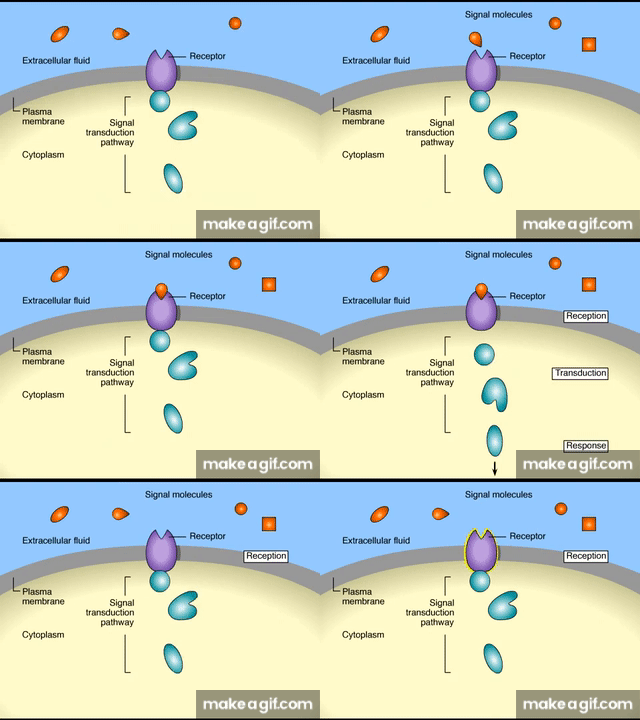
· Describe the ways that cells can communicate with one another.
· Explain how cells communicate with one another over short and long distances
|
# |
Tasks: |
|
1 |
Padlet Activity to help with my attendance! What is your favorite season? Why? |
|
2 |
Updates
on Test Grades
|
|
3 |
Reading and Note-Taking Cell Signaling The textbook does not include a section on
cell signaling. This is an important topic in unit 4. We will use an online
college text called Open Stax AP Biology. Chapter 9.1 Signaling Molecules and Cellular
Receptors Note-taking added to Google Classroom
|
Homework
Upcoming
Assessments
12/11/25 Quiz: Cell
Communication
12/16/25 Quiz: Feedback
12/19/25 Quiz: Cell Cycle
12/22/25 Test: Cell
Communication & Cell Cycle
Calendar Notes
12/24/25 – 1/4/26 Winter Break
1/5/26 School Resumes (unit 5
start)
|
# |
Tasks: |
|
L |
Lab: Enzyme Function – Lactose Action PART A – Lactose, Lactase, and Glucose
Testing Testing lactase enzyme and production
of glucose Complete Table 3. PART B – Yeast consumption of Different
Sugars Testing for the ability of yeast to
metabolize sugars Complete Tables 5., 6., 7. PART C – Lab Report See the instructions to the lab report. |
Homework
Upcoming Assessments
11/7/25 Quiz:
Enzymes November (study guide)
11/17/25 Quiz:
Energy in Living Organism & Photosynthesis
(study guide)
11/20/25 Quiz:
Cellular Respiration (study guide)
The laws of thermodynamics state that energy cannot be created or
destroyed, and each transfer results in a loss of usable energy (entropy). Identify the source of energy for
dehydration synthesis in the diagram. Explain
why this source is used for the energy transfer.